Your Restaurant Is Burning Through More Than Gas
The LPG crisis hitting India's food industry — and how to protect your business right now
The war in the Middle East didn't stay in the Middle East.
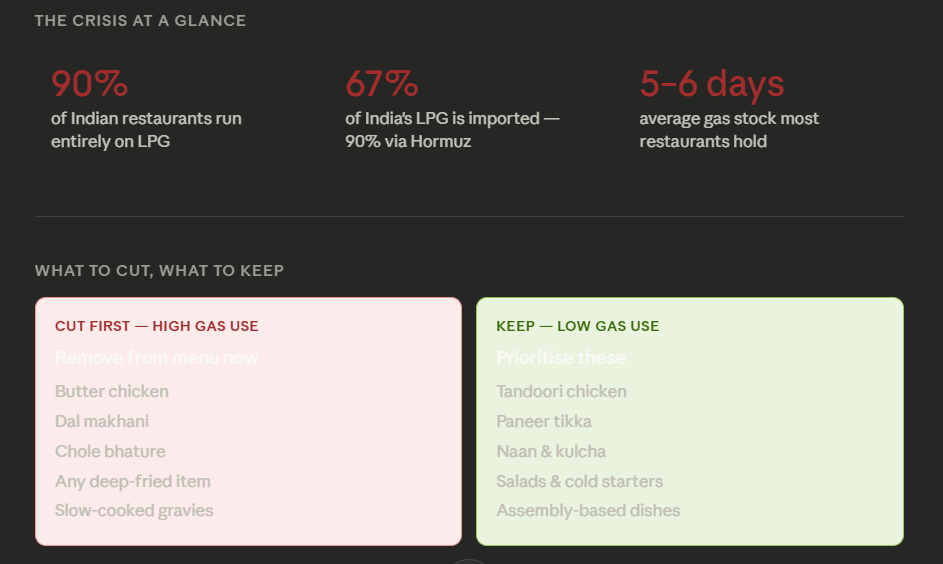
Right now, as you're reading this, thousands of restaurants across India are running on borrowed time — and borrowed cylinders. The US-Israel-Iran conflict has choked the Strait of Hormuz, the narrow waterway through which nearly 90% of India's imported LPG passes. The result? A supply shock that landed directly in your kitchen.
This isn't a rumour or a forecast. It's already happening.
What's actually going on
India imports roughly 67% of its LPG requirement. Almost all of it comes through the Persian Gulf. With military tensions disrupting tanker traffic, shipping costs have surged and cargo movement has slowed dramatically.
The government's response was swift — and painful for commercial operators. It prioritised domestic household cylinders under the Essential Commodities Act, which means restaurants, hotels, and food vendors are at the back of the queue. Commercial LPG cylinders are becoming harder to find, more expensive when available, and in some cities, impossible to get at any price.
Delhi. Mumbai. Bengaluru. Chennai. Lucknow. The shortages are everywhere.
In Lucknow's popular Chatori Gali, 40 food stalls shut down in a single night. In Maharashtra's Thane, over 800 hotels and restaurants are staring at five to six days of gas stock. In some areas, commercial cylinders are being sold on the black market for ₹3,500 — nearly five times the normal price. The National Restaurant Association of India (NRAI), which represents over 5 lakh restaurants, has issued a warning: this will lead to closure of businesses and job losses if LPG supply doesn't stabilise.
One number matters here: 90% of Indian restaurants run entirely on LPG. Most hold less than a week's worth of stock. Your inventory buffer is not just thin — it's dangerous.
What you should do in the next 48 hours
Here's a practical, actionable checklist — not panic, just preparation.
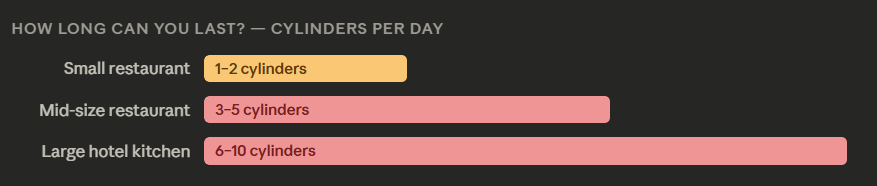
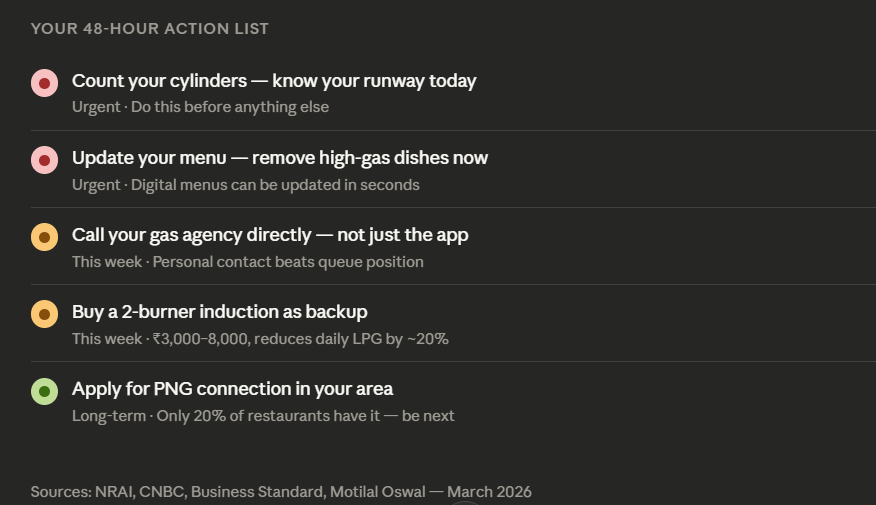
1. Count your cylinders today Know exactly how many commercial cylinders you have and estimate how many days they last at current usage. That number is your runway. Everything else flows from it.
2. Audit your menu for gas consumption Not all dishes are equal. Gravy-based dishes, deep-fried items like chole bhature, and slow-cooked curries burn through gas at 2–3x the rate of tandoor-based or grilled items. Restaurants in Delhi and Mumbai are already voluntarily cutting these from their menus to extend supply. Consider doing the same — even temporarily.
Switch your focus to:
Tandoori dishes (chicken tikka, naan, kulcha, paneer tikka)
Grilled items
Cold starters and salads
Assembly-based items that need minimal heat
If you have a digital menu, update it today. If you're running a printed menu, put a small board near the entrance listing what's available. Don't let customers order and then get a refusal — that kills the experience and the review.
3. Apply for PNG connection immediately Piped Natural Gas (PNG) is still flowing. Currently, 80% of restaurants run on LPG and only 20% on PNG — but those 20% are operating without disruption. If PNG lines are available in your area, start the application process now. It takes time, but it's the only long-term protection against this kind of disruption.
4. Get an induction or electric backup Induction cooktops are flying off shelves right now — there's a reason. For lower-heat tasks like boiling, sauces, and heating pre-cooked items, a two-burner induction setup costs ₹3,000–8,000 and can meaningfully reduce your daily cylinder consumption. It's not a full replacement, but it buys you days.
5. Talk to your gas agency — and your neighbours Your gas agency contact is your most valuable relationship right now. Call them directly, not just through the app. Some operators are coordinating with neighbouring restaurants to pool allocation or share vendors. It sounds unusual, but in a shortage, community wins.
The bigger lesson your restaurant business needs to hear
This crisis is revealing something that was always true but easy to ignore: single points of failure in your operations are existential risks.
Single fuel source. Single supplier. Single menu format that can't be quickly updated. Single revenue channel dependent on platforms that take 25–30% commissions.
India's restaurant industry generates ₹5.7 lakh crore annually and employs 80 lakh people. That's enormous. And yet a narrow strait of water thousands of kilometres away nearly shut it down in a week.
The restaurants that will recover fastest from this — and any future disruption — are the ones that have already built flexibility into their operations. Flexible menus they can change quickly. Multiple energy sources. Multiple revenue streams, including direct orders that don't depend on third-party platforms.
This crisis will pass. The Petroleum Minister has confirmed additional LPG tankers are already en route, and the government is sourcing from 40 countries instead of the usual 27. Normal supply should stabilise within weeks.
But the question worth sitting with is: when the next disruption comes — and there will be one — how many days of runway will your restaurant have?
Build the buffer now. Not just in gas cylinders, but in menu agility, in operational flexibility, and in the direct relationship you have with your own customers.
That's what will determine which restaurants are still standing five years from now.
If you run a restaurant in India and want to make your menu instantly updatable for situations like this, Menuthere lets you edit your digital menu in seconds — no designer, no printer, no delay.