The Vanishing Bill: ₹70,000 Crore of Restaurant Revenue Was Deleted. The Government Just Found All of It.
What the nationwide tax crackdown means for your restaurant — and how to make sure you're not next
What the nationwide tax crackdown means for your restaurant — and how to make sure you're not next
Previous article
The LPG crisis hitting India's food industry — and how to protect your business right now
Next article
A Bengaluru cafe added a Gas Crisis Charge to a lemonade bill. It went viral. And it tells us something important about where the restaurant industry is headed.
It started with biryani.
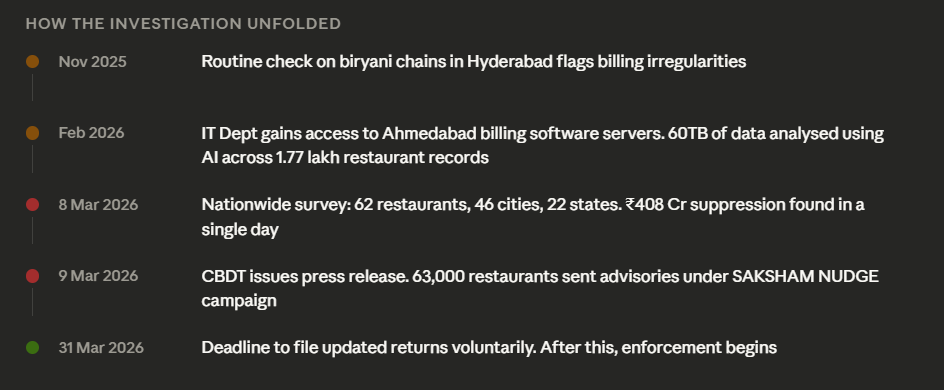
In November 2025, Income Tax officers in Hyderabad began a routine check on a few popular biryani chains. What they found wasn't a small discrepancy. It was a trapdoor, engineered, deliberate, and hidden in plain sight inside software that lakhs of restaurants across India use every single day.
He flags it. His department flags it. And then, quietly, something very large begins to move.
A city. A software company. Sixty terabytes.
The trail leads to Ahmedabad. To a software company whose billing platform sits inside the kitchens of over one lakh restaurants, roughly one in every ten restaurants using billing software in India.
Income Tax officers don't knock on restaurant doors this time. They go straight to the source. They walk into the software company's facility and copy everything. Every transaction. Every invoice. Every deletion.
Sixty terabytes of data. Six years of records. ₹2.43 lakh crore worth of billing history.
They load it into high capacity machines. They run generative AI across it. And then they watch as the pattern emerges, not in one restaurant, not in one city, but everywhere, simultaneously, like a stain spreading across a map of India.
₹13,317 crore worth of bills. Created. Then deleted. After the customer had already paid and walked out the door.
Here's how it worked.
Every modern restaurant billing system records everything in real time. Cash. UPI. Card. It's all logged, partly for efficiency, partly to prevent staff from pocketing money. The owner always knows what came in.
Except some owners knew something else too. They knew the system let them go back in.
At the end of the day, or the end of the month, someone would open the backend. And they would start deleting. Not everything, that would look suspicious. Just the cash entries. Just enough to make the numbers look plausible. Just enough to shave the GST liability. Just enough to quietly keep a slice of the revenue off the books.
Some were surgical about it. Selective deletion, pick a few transactions, leave the rest, make it look like a normal day.
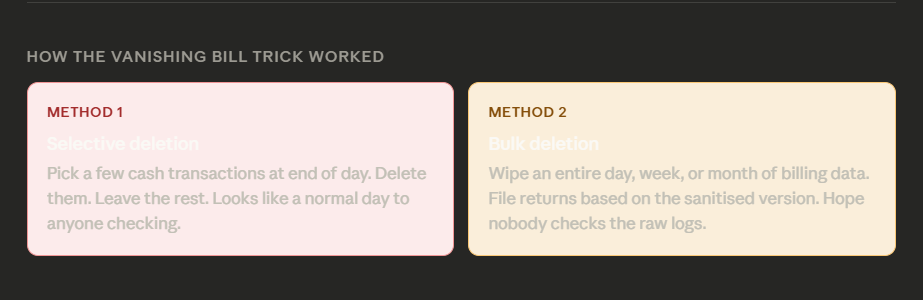
Others were bolder. Bulk deletion, wipe an entire day. Wipe a week. In some cases, wipe a full month. Then file your returns on the sanitised version and hope nobody ever looked at the raw data.
Nobody ever did. Until they did.
The numbers are almost impossible to hold in your head.
March 8, 2026. The CBDT launches a single coordinated nationwide survey. One day. 62 restaurants. 46 cities. 22 states. Madurai to Shimla. Godhra to Guwahati.
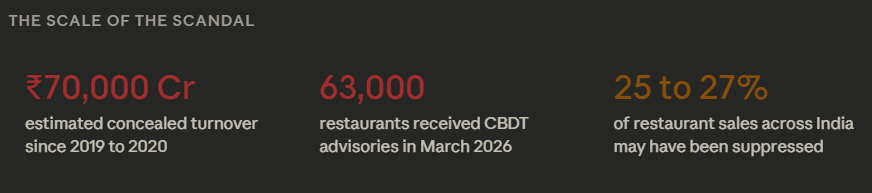
Sales suppressed in just those 62 restaurants: ₹408 crore.
Estimated concealed turnover across the sector since 2019: ₹70,000 crore.
Read that again. Seventy thousand crore. Gone. Vanished. Billed, collected, and then quietly erased from existence.
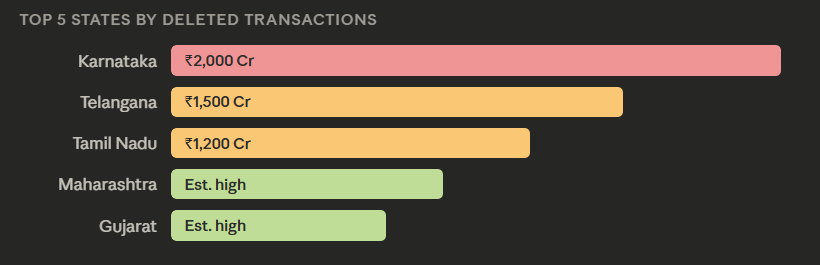
Karnataka alone: ₹2,000 crore deleted. Telangana: ₹1,500 crore. Tamil Nadu: ₹1,200 crore. Maharashtra and Gujarat rounding out a top five that covers most of urban India.
Between 25 and 27% of restaurant sales across the country may have been suppressed this way, according to CBDT's own analysis. Not a few bad actors. Not an isolated scam. A quarter of the industry.
And then the letters started arriving.
63,000 restaurants. That's how many got a message from the Income Tax Department in the days that followed. Not a raid. Not yet. A nudge.
The SAKSHAM NUDGE campaign. An amnesty window dressed in bureaucratic language. File your updated returns before March 31, 2026. Pay what you owe. And we'll treat this as a compliance correction, not a crime.
The subtext was unmistakable: this is your one chance to walk back through the door before it closes.
After March 31, the gloves come off.
What changed? One word.
AI.
For six years, this worked because the gap between what happened and what was declared existed in a space nobody was watching. Tax filings were checked against declared accounts. Declared accounts were checked against each other. The raw billing data sat in the software company's servers, unexamined, irrelevant.
Then the government loaded 60 terabytes into a machine and asked it to look for patterns.
It found them in weeks. GST numbers cross referenced. PAN details matched. Post billing deletions flagged. Timestamps compared. The software that restaurants used to hide revenue became, overnight, the most detailed evidence file the Income Tax Department had ever seen.
The trapdoor didn't disappear. It just became transparent.
This is the part that matters for every restaurant owner reading this, even the honest ones.
The investigation so far covers one billing platform. One. The CBDT has already said others will follow.
If your billing software allows post billing edits, even if you've never touched that feature, even if you had no idea it existed, you are sitting on a vulnerability. Not a crime. A vulnerability.
Because the new standard isn't just "did you file accurate returns?" It's "can you prove, at the transaction level, that your billing records and your tax filings match?"
That's a different question. And a lot of restaurants can't answer it cleanly.
So before an officer asks you to, ask yourself:
Does our billing software log every deletion and edit, with timestamps?
Is there a monthly reconciliation between our billing system and our GST filings?
Can we trace every declared rupee back to a specific transaction in our system?
If the answer to any of those is "I'm not sure", find out now. Not next month. Now.
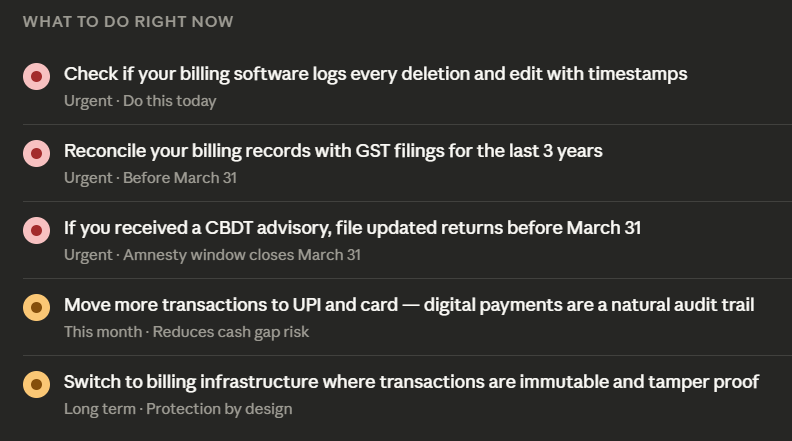
The world your restaurant operates in has permanently changed.
The government has AI. It has data. It has six years of billing records from one lakh restaurants and the computing power to read all of it. And it is going to use these tools, not just once, not just for this investigation, but as standard operating procedure for everything that comes after.
The era when cash could quietly disappear from a bill is over. Not because of new laws. Not because of new rules. Because of new capability.
The restaurants that come out of this cleanly are the ones that built digital, traceable operations before anyone asked them to. Every order logged. Every payment recorded. Every transaction timestamped and immutable. Not because they feared an audit, but because clean infrastructure is just good business.
What happens after March 31 is anyone's guess.
Some restaurants will file. Some won't. Some will gamble that the government's attention moves elsewhere. It won't.
More platforms will be examined. More data will be loaded into more machines. More patterns will emerge.
This isn't a crackdown with an end date. It's a new baseline.
The question every restaurant owner in India needs to answer, right now, today, is simple:
If the government walked into your billing software tomorrow, what would they find?
If you run a restaurant and want every order, payment, and transaction automatically recorded with a clean digital trail, Menuthere builds that into your operations from day one.
Operations
Every restaurant treats "sorry, that's finished" as a small operational embarrassment. Something you apologize for, offer an alternative, and move past.
Operations
Most of your revenue arrives in two or three hours, which means most people meet your kitchen at its worst. And you have never tasted that version.