Your Staff Answers the Same Four Questions Three Hundred Times a Week
Is it spicy? Is it Jain? Does it have onion? Your menu could answer once. On delivery there is nobody to ask, and you never find out what it cost.
Is it spicy? Is it Jain? Does it have onion? Your menu could answer once. On delivery there is nobody to ask, and you never find out what it cost.
Previous article
They loved the food. Then they spent nine minutes trying to catch someone's eye. Memory is built from endings, and the bill is the ending you never designed.
Next article
Every unanswered review is a customer telling the next hundred people what happened, with nobody giving your side. Replying is free and almost nobody does it.
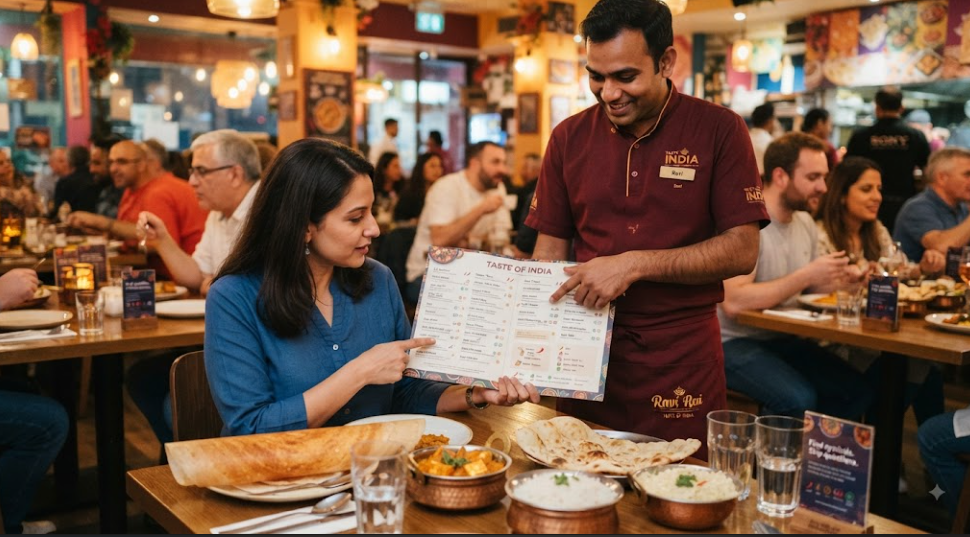
Four questions, asked at nearly every table in India.
Is this spicy? Is it Jain? Does it have onion or garlic? Is there egg in it?
Your staff answer these dozens of times a shift. The waiter often does not know, so they walk to the kitchen and ask someone who is plating during service. One dietary question consumes three people's attention at the worst possible moment.
And it happens again at the next table. And the one after that.
On dine in, an unanswered question costs you a staff minute and a small delay.
On delivery, there is nobody to ask.
The guest looks at your listing, cannot tell whether the paneer has onion in it, and orders from someone else. Or worse, orders from you, finds onion, and writes about it.
That first outcome does not appear anywhere. There is no line in any report for the order that was never placed. You do not experience it as a lost sale. You experience it as an evening that was a little slower than expected.
The delivery menu is the version of your restaurant where the questions cannot be asked out loud, and it is also the version most of your new customers see first.
Most operators believe this is already handled, because the menu has green and brown marks on it.
The veg symbol tells a guest whether the dish contains meat or eggs. That is genuinely useful, and it is one question out of five.
It says nothing about onion or garlic. It says nothing about root vegetables. It says nothing about nuts, dairy, gluten or spice level.
There is a sharper illustration of the gap. <cite index="41-1">The FSSAI green dot indicates only that a product contains no meat or eggs. It does not address root vegetables, fermented ingredients, or multi seeded vegetables</cite>, and <cite index="37-1">honey sits under a labelling carve out that does not require the non vegetarian mark, so a honey containing item can carry the green dot while still not being Jain compatible. The same applies to beeswax and shellac</cite>.
So a dish can be fully compliant, correctly marked, and still be exactly the thing your Jain guest cannot eat.
For reference, <cite index="41-1">the Jain diet excludes root vegetables including onion, garlic, potato and carrot, along with eggs, meat, fermented foods and honey</cite>, and <cite index="37-1">pure asafoetida is the classic flavour substitute for onion and garlic</cite>. That is not a preference to be accommodated grudgingly. It is a framework a guest has followed their whole life, and they are used to restaurants not knowing.
Here is the part that turns this from a courtesy into a revenue question.
The most restricted person at the table picks the restaurant.
A group of six where one person is Jain does not go somewhere that one person cannot eat. A family with a strict vegetarian goes where the vegetarian is comfortable. A table with a nut allergy goes where somebody can answer confidently. A colleague fasting during Navratri decides the lunch venue for the whole team.
That person is not one cover. They are the deciding vote on six.
And they are choosing before they arrive, usually on their phone, from your menu, with no one to ask. If they cannot tell, they pick the place where they can.
Spice level is a preference. A nut allergy is not.
<cite index="43-1">Under Indian food law, eight allergen categories must be declared whenever present: cereals containing gluten, crustaceans, milk and milk products, eggs and egg products, fish and fish products, peanuts and tree nuts, soybeans, and sulphites at or above 10 mg per kg</cite>.
The regulatory direction is clear. <cite index="38-1">The Food Safety and Standards (Labelling and Display) Regulations, 2020 took effect on 1 January 2022 with active enforcement from 1 July 2022, and expect menus, printed and digital, to declare allergens against each dish either as text or easy to understand symbols, alongside the veg and non veg marks in front of each dish name</cite>. Applicability depends on the size and licence category of the operator, so check where your business sits, but the direction of travel is not in question.
There is a practical dimension here too. Staff turnover means the person answering the question may have started on Tuesday. When they do not know, they guess. Guessing about spice is a service issue. Guessing about cashew paste in a gravy is not.
This is the distinction that actually matters, and it is where most menus stop short.
Putting a small symbol next to eighty dishes is compliance. The Jain guest still has to read all eighty and check each one, on a phone, while hungry, hoping the symbols mean what they think they mean.
A filter is different. Tap Jain, see six dishes. Tap no onion no garlic, see fourteen. Tap egg free, see the list.
Same underlying information, completely different experience. One asks the guest to do the audit. The other has already done it.
There is one more question worth surfacing, and it is the highest value of the lot.
Most Indian kitchens can make a good number of dishes without onion and garlic on request. Almost none of them say so on the menu.
So the guest assumes they cannot, and does not ask, and orders the one safe thing or goes elsewhere. A simple "can be prepared without onion and garlic" against the dishes where it is true converts a maybe into an order, and it costs nothing to add because the capability already exists in your kitchen.
1. Count the questions. Ask your floor staff to keep a tally for one week. Which questions, how many times. Most owners are surprised by both the volume and how few distinct questions there actually are.
2. Build attributes, not labels. For each dish, record what it contains rather than what category it belongs to. Onion, garlic, egg, dairy, nuts, gluten. Spice level. Whether it can be made without onion and garlic on request. Attributes can be filtered and searched. A category cannot.
3. Get the allergen list right first. Treat that as safety work rather than marketing work, and have the kitchen verify it dish by dish rather than assuming from the recipe card.
4. Make it filterable. Menuthere supports dietary filters and smart search on your menu, so a guest taps the constraint they live with and sees only what they can eat, rather than reading eighty dishes and hoping.
5. Put it everywhere the questions cannot be asked. Your delivery storefront, your ordering site and your Google listing carry no waiter. That is exactly where the information matters most and where it is usually thinnest.
6. Write it as text, not only as icons. Search engines and AI assistants answering questions like where to find good Jain food nearby can only work from words. An icon is invisible to them.
Four questions, three hundred times a week, answered from memory by whoever is nearest, sometimes wrongly, always at the busiest moment.
The same four questions asked silently on delivery, by people who then order somewhere else, in a way that shows up in no report you have.
Your kitchen already knows every answer. The information exists. It is simply sitting in your chef's head rather than on your menu, where the person deciding can reach it.
Let your menu answer. Menuthere lets you tag every dish with dietary attributes and gives guests filters and smart search across every channel you run.
Sources: eResto (FSS Labelling and Display Regulations 2020 menu requirements), The Fair Labs (FSSAI eight allergen categories), IngrediCheck (Jain dietary framework and the green dot gap), DesiUtils (honey, beeswax and shellac under the veg dot carve out, asafoetida substitution).
Note: applicability of menu labelling requirements varies by outlet count and licence category. Check your own position with a qualified advisor.
QR menus
The fastest way to serve faster is not hiring another server. It is removing the wait that happens before the order is even placed.
Menu strategy
Owners add dishes to grow the order value. It usually does the opposite.