Your Customers Already Decided on Lunch. Then One of Them Left to Order Alone.
The office group picks lunch in a WhatsApp thread, then somebody exits to place the order from memory. Everything lost in that gap was your revenue.
The office group picks lunch in a WhatsApp thread, then somebody exits to place the order from memory. Everything lost in that gap was your revenue.
Previous article
The customer chose the food, filled the cart and tapped pay. Then you asked them to leave your screen and prove they exist. Here is what that step costs.
Next article
One rule decides what you can send, when, and what it costs. Most restaurants learn it from their first invoice. Here it is in plain English, including what changes on 1 October.
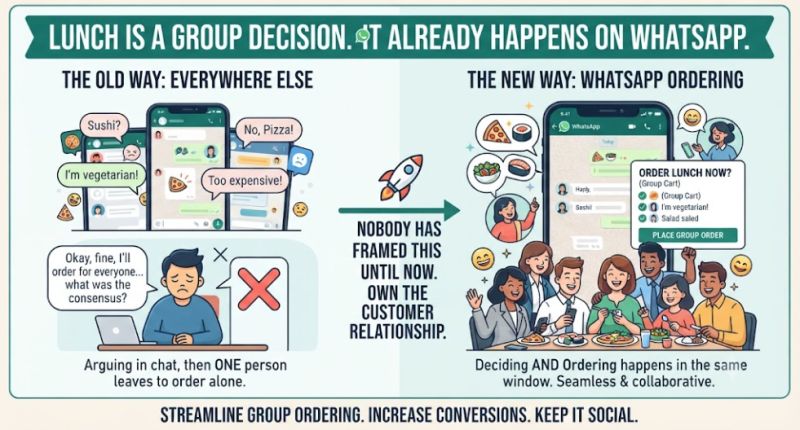
It is 12:40 and somebody types lunch? into the office WhatsApp group.
What follows is a familiar sequence. Biryani. Had that yesterday. Anything veg. I am fasting today. Is that place any good. Someone sends a screenshot of a menu. Two people react with a thumbs up and say nothing else. Eleven messages later there is rough agreement.
Then somebody types: ok I will order.
And leaves.
They exit the conversation where the decision was made, open a different app entirely, and try to reconstruct what eleven people wanted by scrolling back through a thread while a delivery timer runs.
That gap, between the app where the group decided and the app where one person orders, is where your revenue quietly goes missing.
Watch what actually happens to the order in that transfer.
The person ordering defaults to safety. They pick what will not cause an argument, which is usually the plainest common denominator on the menu. Nobody experiments on behalf of eleven colleagues.
Add ons vanish completely. You cannot upsell a proxy. Nobody adds a raita for a person who did not specifically ask for one, and absolutely nobody adds dessert on behalf of a group, because that is somebody else's money and somebody else's opinion. Every suggestion your menu makes at that moment is being read by a person who is not eating the food.
Modifications get dropped. The colleague who mentioned they are Jain said it eleven messages ago, between a joke and a screenshot. The person ordering is tired, hungry and reconstructing from memory. That request has a good chance of not surviving the trip.
And when it does not survive, the complaint lands on you. Not on the colleague who forgot. The food arrived wrong, and your restaurant's name is on the bag.
Then the least pleasant part of the whole ritual begins, which is one person chasing ten others for money for the next three days.
Group orders are not simply bigger orders. They are structurally better ones.
As one operator focused analysis of corporate group ordering put it, the restaurant sees one large ticket rather than ten small ones, on the same delivery run, with the same packaging consolidation. Higher average order value, one delivery cost instead of many, and dramatically lower customer acquisition cost, because one office coordinator becomes a repeat weekly customer rather than ten strangers you have to win individually.
That last point is the one worth dwelling on. A single office lunch coordinator who orders every Friday is roughly fifty group orders a year. You did not acquire fifty customers. You acquired one habit.
And the same analysis identifies exactly why that habit is winnable: the biggest cost of Friday lunch is the planning, not the food. Whoever removes the coordination burden gets the booking, week after week, without competing for it each time.
The corporate ordering platforms have all built a version of the fix. A host opens a group order, shares a link, colleagues add items with their names attached, the host sets a deadline, the cart locks, one delivery arrives labelled and one invoice is issued.
It works, and it is a genuinely good design. It also asks the group to migrate.
The decision is happening in a chat. The tool lives somewhere else. So somebody still has to move the conversation out of the place it is already occurring, get eleven people to open a link, and chase the three who did not.
You have not removed the handover. You have made it slightly nicer.
Now consider what happens when the ordering link opens inside the chat itself.
Someone drops it into the group. Each person taps, picks their own food, and returns to the conversation, which is still happening in the same window. The order consolidates on the restaurant's side as a single ticket.
Nobody exits anywhere. Nobody orders on anybody's behalf. Nobody has to remember what someone said eleven messages ago, because that person chose for themselves.
Three things change on your side of that.
Average order value rises, because eleven people choosing individually will always order more than one person choosing conservatively for eleven. The safe common denominator disappears.
Add ons come back to life. A suggestion shown to the person who is actually going to eat the food converts. The same suggestion shown to a proxy never had a chance.
And the dietary problem solves itself. The Jain colleague picks Jain food. The one who is fasting picks accordingly. Nobody has to carry anybody else's requirements in their head, which is the step where those requirements were getting dropped and where your reviews were getting damaged.
The same shape appears everywhere a group eats.
Family dinner, where three generations have opinions and one person ends up ordering. Friends deciding on a Friday. A hostel floor. A group of colleagues planning a birthday lunch. In every case the deciding happens in a chat and the ordering happens somewhere else, by one designated person, from memory.
India runs an enormous share of its social coordination through WhatsApp groups. Almost every group meal in the country is decided in one, and then ordered outside it.
Group ordering is better revenue and it is also more work, so it is worth being clear about what it demands.
Eleven separate items on one ticket at 1pm is harder for a kitchen than one large single order. Everything needs labelling, because unlabelled bags create a sorting problem at the customer's end, and they will blame the restaurant for it rather than themselves. And you need a cutoff, or the order stays open while one person deliberates and the kitchen cannot start.
Four rules cover most of it.
Set a lock time and communicate it. Fifteen minutes after the link goes in is usually enough, and it also creates the urgency that gets the last three people to order.
Label every item with the name of whoever ordered it. This is the difference between a delivery and a puzzle.
Cap the group size at whatever your kitchen can genuinely produce simultaneously. It is better to decline a twenty person order than to serve it badly.
Invoice properly for offices. A corporate buyer expensing lunch needs an invoice with company details, not a personal receipt. Getting this wrong is how a promising weekly order quietly stops.
Restaurants spend a great deal of energy trying to influence what a customer orders. Menu design, photography, pairing suggestions, offers on the checkout screen.
Almost none of it reaches a group order, because by the time the order is being placed, the group is not there. One person is, working from memory, choosing defensively, adding nothing.
The decision was made by eleven people in a chat. The order was placed by one of them somewhere else. Everything that fell out between those two places was yours.
Put the ordering where the deciding already happens, and most of it comes back.
Let the group order together. Menuthere turns your WhatsApp number into an ordering channel, so a link dropped into a group chat lets everyone pick their own food without leaving the conversation, and the whole thing arrives as one ticket in your POS.
Sources: Ordering.Tools 2026 (group order economics, coordination cost, corporate invoicing requirements), ezCater and Grubhub for Business (group ordering flow, labelling and dietary self selection), Waiter.com (group size thresholds).
WhatsApp ordering
Most operators know this number. It gets quoted in every WhatsApp group in the industry. What gets discussed far less is the second cost, the one that never appears on the invoice.
WhatsApp ordering
You built a structured ordering flow. The customer thinks they are talking to a restaurant. They are not wrong, because it is a chat. Here is how to design for that.