Reviews You Actually Own: Why Your Google Rating Beats Your Swiggy Stars
Your Swiggy rating lives in their app. Your Google rating decides whether anyone finds you at all. Here is how a WhatsApp relationship builds the reviews you own.
Your Swiggy rating lives in their app. Your Google rating decides whether anyone finds you at all. Here is how a WhatsApp relationship builds the reviews you own.
Previous article
Your next 100 customers are within a few km of your door. Here is how geo-targeted Instagram ads routed into WhatsApp turn paid reach into customers you own.
Next article
The office lunch already gets decided in a WhatsApp group. So why does someone have to leave the chat to order it? The group order is the most under-served order in the business.
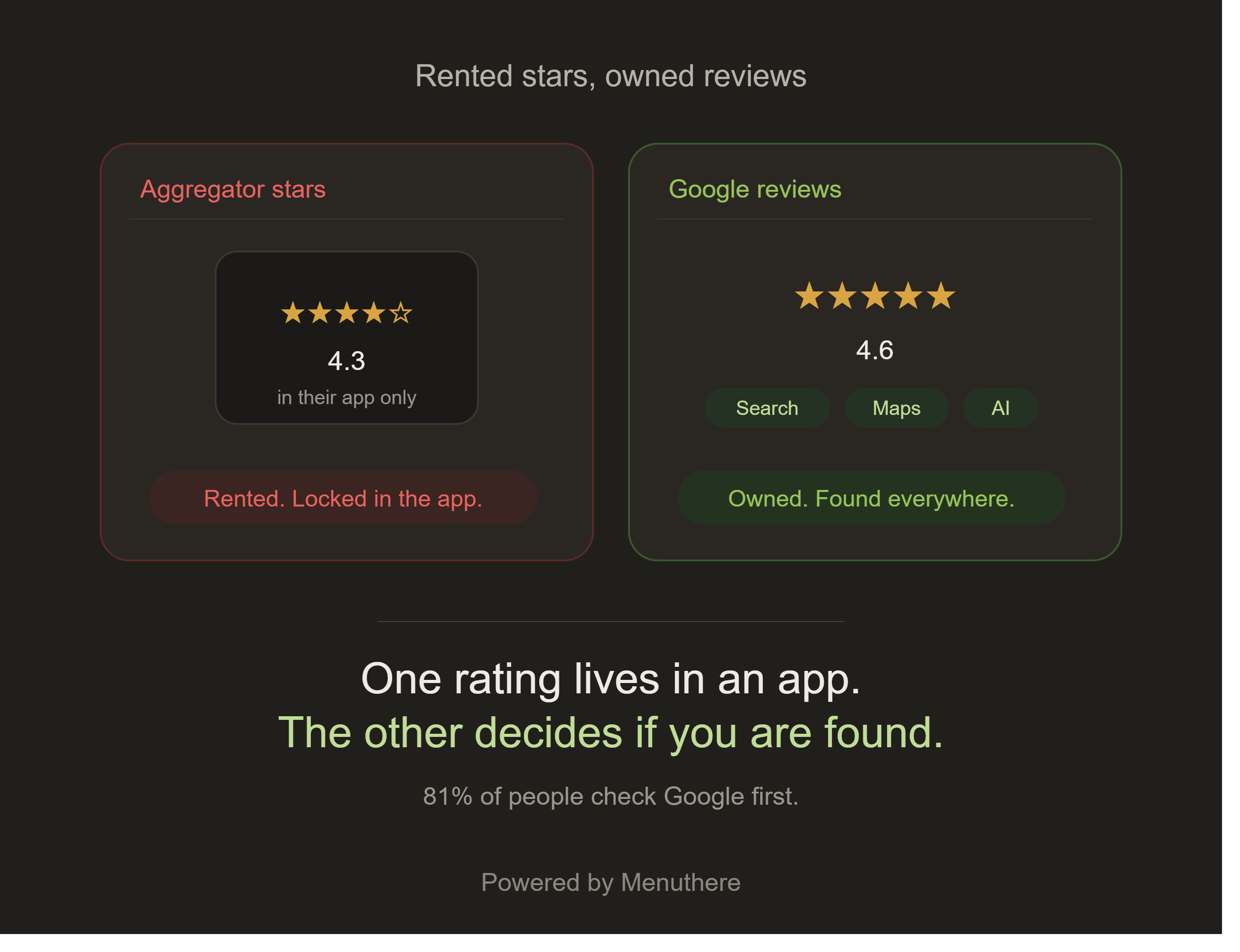
Your Zomato rating and your Google rating are not the same asset, and most owners treat them as if they are. One of them lives inside an app and helps you only while you are listed there. The other decides whether a hungry stranger ever finds you in the first place. And only one of them can you actually build on your own terms.
The aggregator stars feel important because you see them every day. But they are rented reputation. They sit on someone else's platform, they help you only inside that platform, and the day you are buried in the ranking or you leave, they evaporate. The reputation that genuinely moves your business is the one customers see before they have chosen any app at all, and that lives on Google.
When a person decides they want to eat, the first thing they do is search, and they search on Google. Google hosts about 71 percent of all online reviews, 81 percent of consumers go to Google first to check out a business, and roughly 64 percent of diners look at Google before deciding where to eat. Nearly nine in ten local mobile searches turn into a visit or a call within a day.
It is not just about being chosen, it is about being found. Appearing in Google's local three result map pack drives around 126 percent more traffic and 93 percent more direct actions than the listings below it. And the bar is rising again, because AI answers from Google's own overviews, and from tools like ChatGPT and Perplexity, now read review signals to decide which restaurants to recommend. Reviews used to convince people who already found you. In 2026 they decide whether you are found at all, across search, maps and AI at the same time.
This is not a soft branding point. Harvard Business School research found that for independent restaurants, each additional star on the rating translated into a 5 to 9 percent increase in revenue. Chains saw no effect, because their brand already does the trust work. For an independent restaurant, the star rating is the brand. Moving a single location from 3.8 to 4.5 stars can be worth tens of thousands of rupees a year, with no ad spend and no new hires.
The thresholds are just as stark. Restaurants at 4.5 stars and above get far more bookings than those at 4.0 and below. More than half of consumers will not consider a business under 4.0, and a profile below 3 is invisible to almost every searcher. Your rating is a filter that runs before a customer ever sees your food.
Here is the trap. Satisfied customers rarely leave a review on their own. They enjoyed the meal, they moved on with their day. The people most motivated to write are the unhappy ones. Left alone, your public rating drifts below the quality of your actual service, because only the annoyed bothered to type.
The single biggest lever for fixing this is almost embarrassingly simple. Ask. When customers are asked for a review at the right moment, about 83 percent of them actually leave one. The restaurants with strong, recent, high volume ratings are not lucky. They ask, consistently, and they ask at the moment the customer is happiest.
And this is exactly where the aggregator model fails you. To ask someone for a Google review, you need a way to reach them. An aggregator order gives you stars locked inside the app and no contact at all. You served the food, you earned the goodwill, and you have no way to turn that goodwill into the review that actually drives discovery. The platform keeps the customer, so the platform keeps the only path to the review.
You end up with a rating you cannot grow, on a platform you do not control, while the rating that genuinely matters, your Google profile, sits starved of the reviews your happy customers would gladly leave if only someone asked.
A direct relationship fixes the asymmetry completely, because it gives you the two things asking requires: the contact and the moment. When a customer orders through WhatsApp, you have their number and you know they just had a good experience. A simple, warm follow up, a thank you and a one tap link straight to your Google review page, converts that goodwill into a public review while the meal is still fresh.
Recency makes this even more powerful. Around 73 percent of people trust only reviews from the last month, so a steady trickle of fresh reviews driven by your WhatsApp follow ups beats a pile of old ones gathering dust. A relationship you own turns into a review flow you control, which turns into the discovery that brings the next stranger to your door.
A word on doing it right. Ask genuinely and make it easy, but never buy reviews, never fake them, and do not only chase the happy ones while hiding the rest. Google removes manipulated reviews and regulators now fine fake ones. The honest version is also the durable one: serve well, ask everyone, make it one tap.
Step back and the pattern is the same one that runs through everything. Aggregator stars are rented reputation, locked in an app, helpful only there, gone the day you are. Google reviews are owned reputation. They show up wherever people look, in search, on the map, and now in AI answers, and you control the flow of them through the relationships you keep.
And they compound. More recent reviews lift your map ranking, higher ranking drives more discovery, more discovery brings more guests, and more guests, asked at the right moment, leave more reviews. That flywheel is owned discovery, the exact thing an aggregator rents back to you at a premium. Build it once and it keeps turning.
Your Google profile is where most new customers meet you, long before your website or any app. Keep it complete, current and full of fresh reviews.
You cannot request a review from a customer you cannot reach. A WhatsApp ordering relationship gives you the contact that makes the ask possible.
Right after a good order, send a warm thank you and a single tap link to your Google review page. Easy and well timed beats clever every time.
Recency beats volume, so a steady stream of new reviews matters more than a big number that is years old. Make the ask a routine, not a one off campaign.
Replying to reviews, good and bad, lifts both ranking and trust, and almost everyone reads the responses. Silence reads as indifference.
Authenticity is the whole point. Ask all your customers, let the honest picture show, and let consistent good service do the work.
Track your average rating, how many fresh reviews you are getting each month, and where you sit in the local map pack. Those three numbers tell you if the flywheel is turning.
Your aggregator rating is a number you rent inside someone else's app. Your Google rating is the reputation that decides whether a stranger ever finds you, and it is worth real, measurable revenue per star. The only reason most restaurants have a weaker Google profile than they deserve is that their happiest customers were never asked.
The aggregator keeps those customers out of reach. A direct relationship hands them back to you, along with the moment to ask. Own the relationship, ask at the right time, make it one tap, and you build the one kind of reputation that follows you everywhere and belongs to you alone.
Own your reputation. Menuthere turns your QR menu into a WhatsApp ordering channel, so every happy customer is a contact you can thank, and ask for the Google review that actually brings the next guest.
Sources: Harvard Business School research on star ratings and independent restaurant revenue, BrightLocal Consumer Review Survey, and 2026 Google review and restaurant local search data from BrightLocal, Restroworks, SocialPilot and related industry reports.
Menu strategy
Most restaurants think of the menu as something that happens after a customer has chosen them. They sit down, you hand it over, they read it.
WhatsApp ordering
Most operators know this number. It gets quoted in every WhatsApp group in the industry. What gets discussed far less is the second cost, the one that never appears on the invoice.