Rented Visibility: Why You Do Not Own a Single Customer on Swiggy or Zomato
On the apps your top spot is rented, not earned, and your customer was never yours. Here is the rented visibility trap, and how to own your audience instead.
On the apps your top spot is rented, not earned, and your customer was never yours. Here is the rented visibility trap, and how to own your audience instead.
Previous article
That "Flat ₹125 off" was not the platform's gift to your customer. You paid for it. Here is how the discount trap shrinks profit while volume grows.
Next article
On the apps, the platform owns your customer, not you. Here is why the customer relationship is the spine of your brand, and how to own it through WhatsApp.
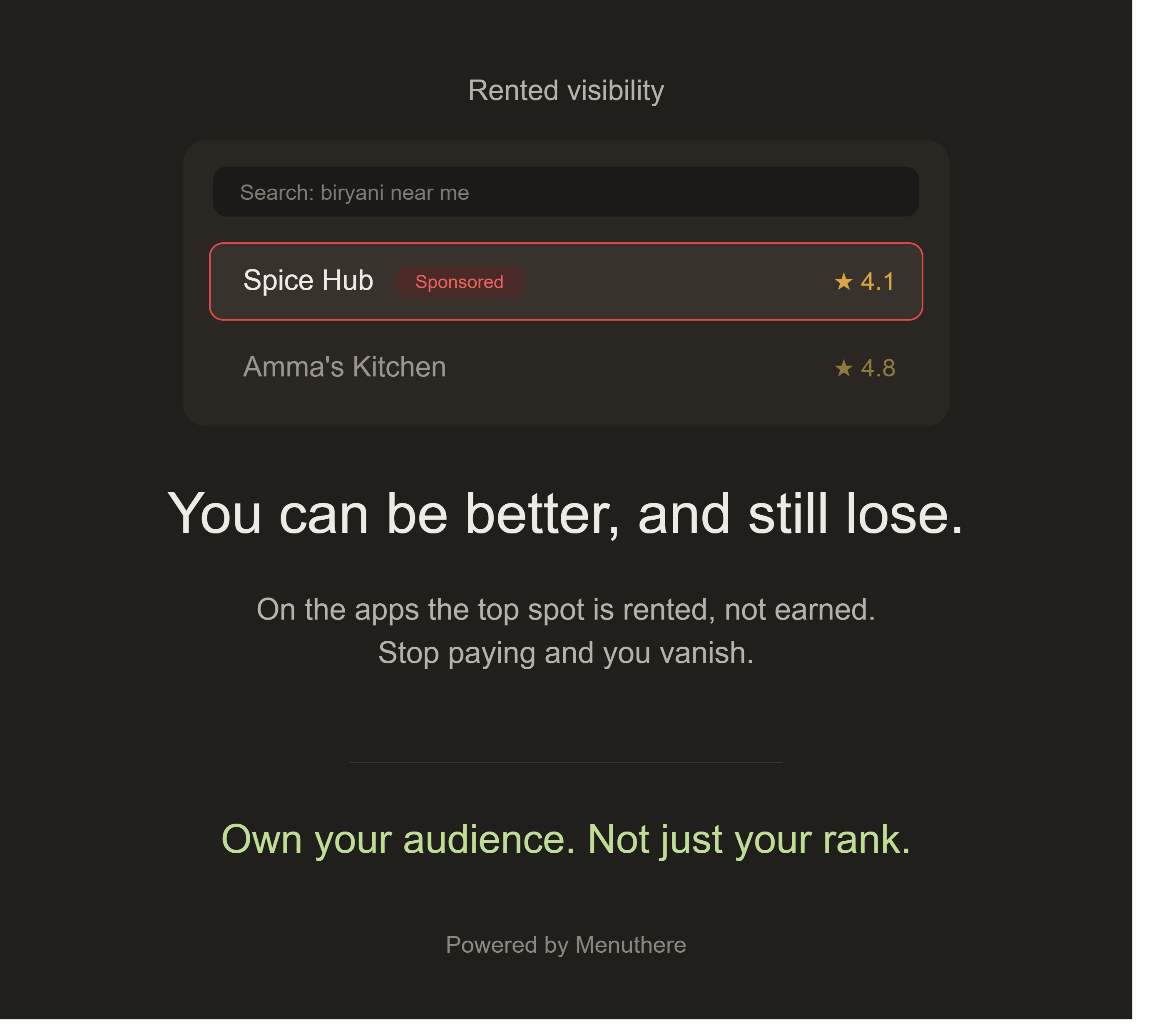
You can be the best restaurant in your neighbourhood, with the freshest food and the highest ratings, and still lose. On the apps, the place at the top of the list is not the best one. It is the one that paid the most to be there.
That single fact explains why the aggregator relationship feels less like a marketplace and more like a landlord. You do not own your spot. You rent it, by the order, by the month, forever. And the customer you cooked for was never yours either. This is the rented visibility trap, and it has two halves: a rank you rent, and an audience you never owned.
The old model was simple, one commission rate for everyone. That is gone. Both platforms have moved to tiered commissions, where your rate depends on your location, your volume and the plan you pick, and to paid priority listing, often bundled into programs branded around their subscriber base, that pushes you higher in search results for an extra fee.
The result is a two layer system where restaurants that pay more get seen more. Visibility itself is now a line item, sold back to you as a service. And because the ranking rewards ad spend, a mediocre restaurant that buys placement can sit above a far better one that does not. Your reviews, your food, your years of work, all of it can rank below a competitor whose only advantage is a bigger marketing budget.
Here is what makes it a trap rather than just a cost. The visibility you buy disappears the moment you stop paying for it. There is no equity in it. A restaurant that spends two years buying its way to the top of the list does not own that position at the end. Stop the spend and you fall back into the crowd the same week, as if the two years never happened.
That is the definition of rent. You pay continuously to occupy a space you will never own, and the price is set by the landlord, who can raise it whenever the auction heats up. Worse, you are often bidding against other restaurants, and sometimes against the platform's own brands and cloud kitchens, for the attention of customers who are standing right outside your door.
The second half is quieter and more damaging. For most of the last decade, the platforms masked customer data. The names, the phone numbers, the order histories, the locations, all hidden from the restaurant that actually made the food. You could serve the same person their Friday biryani fifty times and never learn their name or be able to reach them.
That data did not vanish. It belonged to the platform, which used it to build recommendations, to personalise pricing, and to power its own subscription programs. You generated the relationship. They kept the asset. The restaurant industry took this fight all the way to the Competition Commission of India, arguing that masking customer data was anti competitive, precisely because a business that cannot see its own customers cannot build anything that lasts.
There is real movement now. After years of pressure from the restaurant association, a long running CCI case, and competitive heat from a new entrant that started sharing customer data with restaurants, Zomato agreed to pilot an opt in model where customers can consent to share their contact details, and Swiggy is expected to follow.
This is progress, and it is worth welcoming. But read the shape of it. The data sharing is consent based and platform controlled, switched on inside their app, on their timeline, framed around their idea of marketing updates. It is the landlord offering to slide a copy of the tenant list under the door, when he feels like it. Better than nothing. A long way from owning the building.
The lesson is not to wait for permission to own your audience. It is to start building an audience that was always yours.
Strip it all back and the choice is between two kinds of asset. Rented visibility is a position you pay for continuously and lose the instant you stop. An owned audience is a list of customers, with their numbers and their order history, that stays with you whether or not you spend a rupee on ads this month, and that gets more valuable every time someone reorders.
One is an expense that resets to zero. The other is an asset that compounds. Most restaurants are pouring money into the first while owning almost none of the second.
Calculate what you spend on priority listing and ads, and judge it the way you judge rent, as a recurring cost for temporary access, not as something you are building. That framing alone changes how much you are willing to pour in.
Discovery is the one thing the platforms genuinely do well. Treat a new aggregator customer as an introduction you paid for, and make it your job to move that person onto a channel you own before they become a regular you keep re renting.
Do not wait for an opt in toggle inside someone else's app. A direct ordering channel gives you the customer's number, with consent, the first time they order from you. Menuthere turns your QR menu into a WhatsApp ordering channel, so every order builds a list of customers that belongs to you, not to a platform.
The phone number is the asset. Ask for permission to send order updates and offers at checkout, and that single opt in becomes the foundation for reorders, win backs and loyalty that no algorithm change can take away.
It is absurd to pay for priority placement to win back a guest who already loves your food. Once someone is in your owned audience, the reorder should happen on your channel, at full price, with no rent paid to be seen.
Google, Instagram, your own QR codes and the open network all bring new guests too. The more ways people find you, the less power any one platform has to raise your rent.
The top of the search results is not a prize you win. It is a space you rent, at a price the landlord sets, and you lose it the moment you stop paying. The customer who orders through it was never on your books to begin with. That is a fragile place to build a business.
The restaurants that thrive from here will still use the apps to get found. But they will treat that visibility as rent, and put their real energy into the one asset that compounds, an audience they own. The platforms are slowly, reluctantly, admitting that restaurants should be able to reach their own customers. You do not have to wait for their permission to start.
Own what you build. Menuthere turns your QR menu into a WhatsApp ordering channel, so every order adds to a customer list that is yours to keep. See how it works →
Sources: Restaurant Coach (tiered commissions and paid priority listing), reporting on aggregator ranking and ad spend, National Restaurant Association of India and Competition Commission of India filings on data masking and platform neutrality, and 2024 and 2025 reporting on Zomato and Swiggy consent based data sharing.
Aggregators
Aggregator money arrives in 7 to 14 days, minus a third, in a lump you cannot reconcile. The vegetable vendor wanted cash on Monday morning.
Menu strategy
Your demand has two peaks because of what you chose to sell. The split shift is downstream of menu design, and India's new labour codes just raised the price of it.