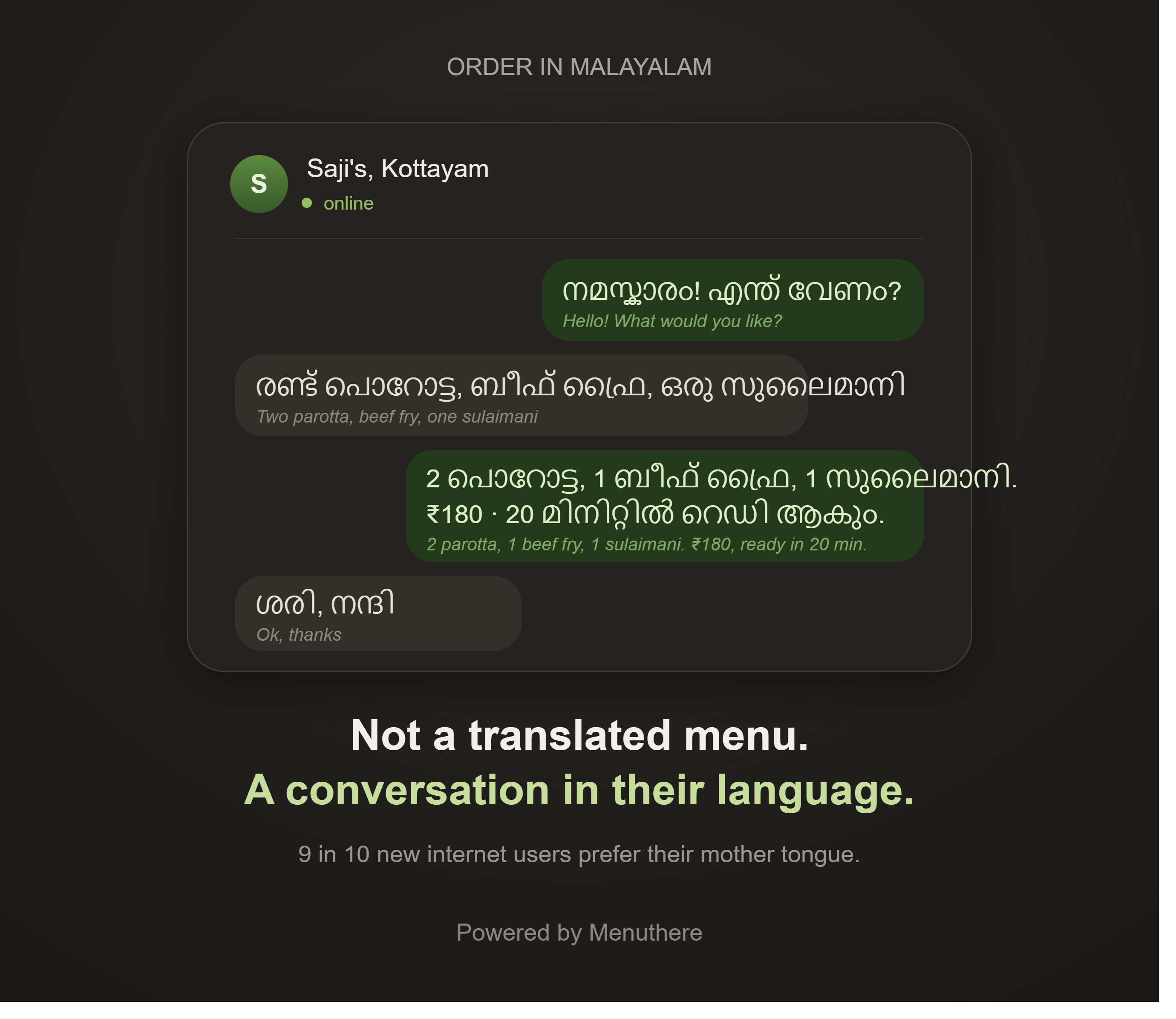
You can translate your entire menu into Malayalam and still force every customer to order in English. It sounds like a contradiction, but it is what most digital ordering actually does. A menu is a list. Ordering is a conversation. Translating the list is a nice start, but the thing that actually builds loyalty is letting the whole conversation, the greeting, the questions, the special requests, the thank you, happen in the customer's own language.
That is the difference between a multilingual menu and ordering in Malayalam. One translates what you sell. The other changes how it feels to buy from you. And for a restaurant whose customers are Malayali, the second one is where the warmth, the trust, and the repeat business live.
Your customers already think in Malayalam
Start with the scale of who is being asked to order in English. Fewer than 1 percent of Indians speak English as their first language, and under 10 percent use it at all. Indian language internet users already outnumber English ones by more than two to one, and they are growing several times faster. Google has found that over 90 percent of new internet users prefer to browse in their native language even when they understand English.
Now look at how most ordering works. Aggregator apps are English first by design, and even a lot of digital menus default to English. Every one of those screens sends a quiet signal to the Malayali majority: this was not really built for you. Meeting a customer in Malayalam is not a soft, feel good extra. It is respect, and respect converts. Consumers are up to 70 percent more likely to buy when the experience is in their mother tongue, and 88 percent more likely to respond to messaging in their local language. Speaking your customer's language is one of the highest return decisions a local business can make.
A translated menu is a veneer. A conversation is the real thing
Here is the distinction that matters, and it is easy to miss. A multilingual menu takes your list of dishes and renders it in Malayalam script. Useful, especially for visitors who cannot read English. But the customer can still be trapped in a stiff, English shaped, tap through transaction, where the only Malayalam is the name of the dish and everything around it, the flow, the prompts, the confirmation, feels foreign.
Ordering in Malayalam is different and deeper. The greeting arrives in Malayalam. The customer types or says what they want in Malayalam. The question comes back in Malayalam: less spicy for the children? The confirmation, the "ready in twenty minutes," the thank you, the apology if something is wrong, all of it in Malayalam. The customer is not decoding a translated form. They are having a conversation, in the language they think and joke and argue in. The menu is what you sell. The conversation is how it feels to be your customer.
Language is intimacy, and intimacy is loyalty
There is a reason this matters so much more than it seems. People are simply more themselves in their mother tongue. They are more comfortable, more expressive, more honest, and more loyal. A customer who can write to you in Malayalam asks the things they would never bother to type in English: is today's fish fresh, can you make it the way my mother did, is the sadhya booking still open. They specify their preferences better. They complain more openly, which is a gift, because an honest complaint in a chat is a chance to fix it and keep them, instead of a silent switch to a competitor.
And it changes what your restaurant feels like. A place that talks to you in Malayalam feels like your neighbourhood spot, run by people like you. An English app feels like a corporate form you are filling in. For a local restaurant, that warmth is not a nicety, it is the entire competitive advantage over a faceless platform. You cannot out spend Swiggy. You can out belong it.
It handles what an English form mangles
Malayalam is not one flat thing, and that is exactly what a rigid English menu cannot cope with. The same dish carries different affectionate names across Kerala. Families have their own words for things. People slide between Malayalam and English in a single sentence, the Manglish that is how Kerala actually talks. An English form accepts only the exact listed name of a dish and rejects everything else.
A conversation absorbs all of it. The customer names the dish the way their family names it, in the dialect of their town, half in Malayalam and half in English, and a restaurant that is genuinely listening simply understands. You meet people in their real language, not a sanitised, dropdown friendly version of it.
This is not the same job as the tourist menu
It is worth being precise, because these two things get confused. A multilingual menu that shows your dishes in English, Arabic, or Hindi helps a visitor understand you. That is real value, and Kerala's millions of tourists are a good reason to have one. But that is translation for outsiders, so they can read what you offer.
Ordering in Malayalam is the opposite direction. It is not about helping a stranger understand you. It is about letting your core, local, repeat customer interact with you in their own language. One serves the occasional guest. The other serves the regulars who actually keep your lights on, week after week. You want both, but do not mistake one for the other, and do not let a translated menu convince you that you have already done the more important job.
Why the apps cannot, and where this lives
An aggregator is an English first, structured catalogue. There is nowhere in that model for a warm exchange in Malayalam, because the model is a form to complete, not a conversation to have. This can only happen where conversation already happens, on WhatsApp, and only when a restaurant chooses to speak its customers' language rather than making them adapt to an app's.
Doing it well, honestly
This is where it pays to be straight, because ordering in Malayalam is not simply a matter of translating a few buttons. The prompts, greetings, and confirmations should be genuinely, warmly Malayalam, and that part is very achievable. Understanding a free flowing Malayalam or Manglish order automatically is much harder, because dialect, romanised versus script, and code mixing trip up machines in ways they do not trip up a human ear.
So the reliable path is to make everything the restaurant says beautifully Malayalam, and to keep a person in the loop, or a clear read back, for the free text order itself, rather than promising flawless automatic understanding. Warmth and accuracy first. Automation earns more of the job as it proves it can be trusted with the dialect your customers actually speak.
The playbook
1. Make the whole interaction Malayalam
Localise the conversation, not just the menu strings. The greeting, the questions, the confirmation, and the thank you should all be in Malayalam.
2. Greet, confirm, and thank in the mother tongue
The words around the order matter as much as the order. A Malayalam hello and a Malayalam thank you are what make it feel like a neighbour, not a form.
3. Accept the order as they actually say it
Let people use the local name, the dialect, and the Manglish mix. Do not force the exact English name of a dish.
4. Offer text or voice
Some will type Malayalam, many will prefer to speak it. Let the customer choose the input, as long as the language is theirs.
5. Keep a person in the loop
Until machine understanding of local speech and script is truly reliable, verify free text orders. Accuracy protects the trust that language earns.
6. Keep the tourist menu a separate job
A multilingual menu for visitors and mother tongue ordering for locals are two different things. Do both, on purpose, and do not confuse them.
7. Make language your identity
Be the restaurant that speaks your customers' language. In a market of English first apps, that is a position no platform can copy.
The bottom line
The digital era quietly decided that ordering food should happen in English, on a form, and it left the Malayali majority translating their own cravings into a language they do not live in. Translating your menu is a start. Letting the whole conversation happen in Malayalam is the real thing, and it is where comfort, honesty, and loyalty come from.
Your customers already think in Malayalam. The restaurant that lets them order in it, greet in it, complain in it, and be thanked in it, becomes their place in a way no English app ever can. Speak their language, and you stop being an option and start being home.
Speak your customers' language. Menuthere turns your QR menu into a WhatsApp channel where the whole conversation, not just the menu, can happen in Malayalam, by text or by voice.
Sources: 2026 vernacular internet data from Google, KPMG and Brill Creations on Indian language internet users versus English, native language browsing preference, and purchase and response rates in local languages, and Ken Research on English as a first language in India.