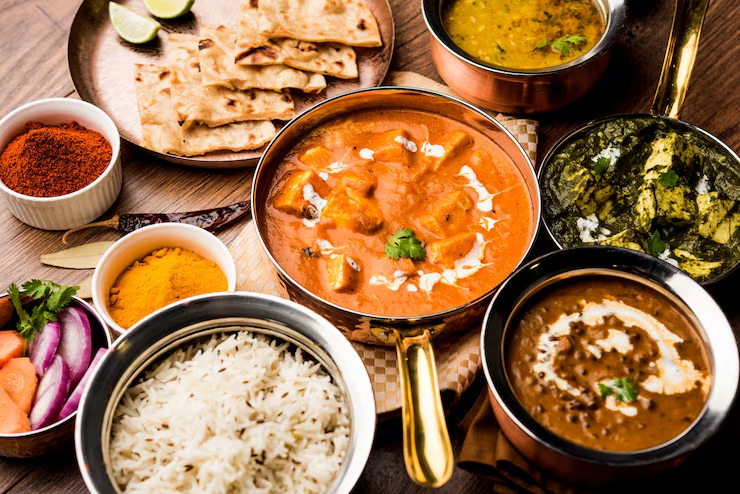
Walk into any independent restaurant in Bangalore, Mumbai, Delhi, or Hyderabad today and count the screens.
There's the Petpooja terminal at the billing counter. A Swiggy tablet next to it. A Zomato tablet next to that one. Sometimes a Magicpin or DotPe device too. Maybe a separate tab for WhatsApp orders. A printed menu on each table. A laminated takeaway menu at the counter. And a dusty menu PDF on the restaurant's website that nobody has updated since 2022.
Every one of those surfaces is showing a different version of your menu.
And somehow, the Indian restaurant tech conversation in 2026 has decided the next big investment is AI-powered kitchen robotics.
To be blunt: for the 500,000+ independent restaurants that make up the Indian food services industry, this is a wildly misplaced priority. You don't need Flippy the robot frying your bhatura. You need the six menus running across six different systems in your restaurant to finally agree with each other.
The Indian restaurant reality check
First, the size of the opportunity. According to the NRAI India Food Services Report 2024, the Indian food services industry is valued at Rs 5,69,487 crores and is projected to hit Rs 7,76,511 crores by FY28, growing at a compound annual rate of 8.1 percent. The organized segment is growing faster at 13.2 percent CAGR. India is on track to become the third largest food services market globally by 2028, overtaking Japan.
That growth isn't coming from robot kitchens. It's coming from urbanization, rising disposable income, tier 2 and tier 3 city expansion, and a young population that eats out and orders in constantly.
And here's the part that matters for operators. Zomato handles roughly 58 percent of online food delivery in India. Swiggy handles 34 percent. Between them, they control over 90 percent of the digital ordering market, with commissions of 22 to 25 percent per order. Petpooja has become the default POS for independent restaurants, integrating with over 200 third party services.
The Indian restaurant operator's life is defined by juggling these platforms, not by thinking about AI robotics.
The real Indian restaurant pain point
Here's the actual problem nobody is solving cleanly.
Imagine you own a 3-outlet biryani restaurant in Hyderabad. You want to launch a new item: Lucknowi Dum Biryani, Rs 320. Here's what you actually have to do to make that happen:
Add it to your Petpooja POS so billing and kitchen orders work
Log into Swiggy's partner portal, upload a photo, add description, set price, wait for approval (can take 24 to 48 hours)
Log into Zomato's partner portal, do the same thing (separately, with different image requirements)
Update the QR menu on each table (if you have one) or get new printed menus made
Update the takeaway menu at the counter
Update your Instagram bio link menu
Hope your staff remembers all of this
If ingredient prices spike next month and you need to raise the price from Rs 320 to Rs 340, you do all seven things again.
If you run out of an ingredient at 9 PM and need to 86 the item, you do... honestly, most operators don't update it anywhere. They just tell customers "sir, finished" when orders come in. Which means Swiggy and Zomato customers still order it, then get cancellations, which hurts your rating on both platforms.
This is the real state of menu management for Indian independent restaurants in 2026. It's not a kitchen AI problem. It's a menu coordination problem.
Why kitchen robotics is the wrong answer for India
The American restaurant industry is investing in Miso Robotics and PreciTaste because American kitchens have a labor cost problem. A single kitchen worker in the US costs $15 to $20 an hour. Automating fry stations saves real money at that labor rate.
Indian kitchens do not have that problem. Labor in India is abundant and affordable for independent restaurants. Automating a fry station in a Bangalore restaurant doesn't save meaningful money. It costs money, both in capital and in maintenance.
The Indian independent restaurant's actual cost and revenue leaks are elsewhere:
22 to 25 percent commission loss on every Swiggy and Zomato order
Revenue lost when customers order 86'd items and cancel
Staff time lost to manually updating menus across 5-7 different platforms
Price mismatch issues where Swiggy shows Rs 320 but Zomato still shows Rs 280
Menu drift where aggregator menus become outdated and don't match what the kitchen actually serves
GST billing compliance issues when menu items change
Fixing these leaks is worth lakhs of rupees a year to an independent operator. Installing kitchen automation is worth a fraction of that, and the capex is much higher.
For Indian restaurants, the return on menu intelligence is dramatically higher than the return on kitchen robotics.
What menu intelligence actually means for an Indian restaurant
Menu intelligence, in the Indian context, is much simpler than the US "AI-driven everything" conversation. It comes down to one thing:
A single menu source of truth that syncs everywhere your restaurant shows up.
That means:
Your Petpooja POS, Swiggy menu, Zomato menu, QR table menu, and takeaway menu all pulling from the same place
Price changes happen in one place and propagate everywhere in minutes, not days
An item gets 86'd in the POS and disappears from Swiggy and Zomato automatically
A new LTO launches across all channels at once, not in sequence over a week
Photos, descriptions, and modifiers are managed once, not six times
GST-compliant billing happens naturally because the menu and POS are aligned
This isn't futuristic technology. It's the basic operational hygiene Indian restaurants have been lacking because nobody has built it end to end.
Where Menuthere fits
This is exactly the problem Menuthere is built to solve, starting with our Petpooja integration.
When Menuthere syncs with your Petpooja POS, your digital menu (QR table menus, website menu, WhatsApp ordering link) stays automatically aligned with what your kitchen knows. Price changes flow through. 86'd items disappear from the customer's view in real time. New items appear across all your surfaces as soon as you add them to Petpooja.
We're building towards the bigger vision where the same source of truth also syncs to Swiggy, Zomato, and your aggregator menus. But even today, the Petpooja + digital menu sync alone eliminates a huge chunk of the coordination tax Indian restaurant operators pay every week.
This is much more relevant to an independent Indian restaurant owner than any of the kitchen AI story the industry press is currently focused on.
The Indian operator playbook for restaurant tech in 2026
If you run 1 to 5 restaurants in India and you're thinking about technology investments this year, here's how to prioritize:
1. POS first. If you're not on Petpooja or an equivalent modern POS, start there. This is the foundation every other tech decision sits on.
2. Menu sync second. Connect your POS to a digital menu that your customers actually see. QR menus on tables are the cheapest, highest-ROI move. Customers get a live menu with photos and descriptions. You update it once and it reflects everywhere.
3. Aggregator discipline third. Spend real time on your Swiggy and Zomato operations. Photos, descriptions, categories, and rankings matter enormously. Badly run aggregator menus cost you orders every day.
4. Inventory and analytics fourth. Once the menu is synced everywhere, start using the data. Which items are actually selling at which dayparts on which channels? Which modifiers get picked most? This is where menu engineering starts earning real money.
5. Kitchen automation last, maybe never. For 1-5 location independent restaurants in India, the ROI case for kitchen robotics simply isn't there yet. Spend those rupees on menu, marketing, and customer experience instead.
The bottom line
The global restaurant tech conversation in 2026 is dominated by American stories about AI kitchens and robot fry stations. That story is not the story that matters for Indian restaurants.
The Indian restaurant story in 2026 is about getting six disconnected menus down to one, getting your Petpooja POS talking cleanly to every customer surface you have, and using the time and money saved to focus on what you actually do well: great food, loyal customers, and growing from one outlet to three.
Robot chefs aren't coming to save your kadai paneer. But a menu that finally syncs everywhere your customers see it? That's available now, and it'll do more for your P&L than any robot will in the next five years.
Want your menu to stay in sync across Petpooja, your QR codes, and your customer-facing surfaces automatically?
Menuthere is built exactly for independent Indian restaurants that are tired of updating the same menu six times.
Sources: NRAI India Food Services Report 2024; NRAI Indian Restaurant Summit 2025; Petpooja product documentation; Restroworks Indian restaurant industry statistics; IBEF restaurant industry analysis; KrASIA analysis of Zomato-Swiggy duopoly dynamics.